Understanding the FA Three-Player Core Moves
Football is a dynamic game that thrives on teamwork, communication, and skilful execution of plays. Among the fundamental skills players need to develop, the three-player core moves—round the corner, lending pass, set back pass, up back and through, and three in a line—are essential for maintaining possession, creating space, and breaking through defensive structures. These moves featured in 20% of all open play goals in the 2022 world cup. In this article, we will explore each of these core moves in-depth and provide strategies for effectively coaching them.
Round the Corner
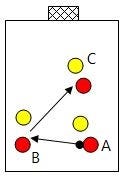
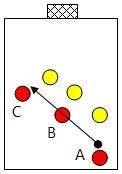
This move is used when the passing lane to a teammate in a better position is blocked by the direct opponent to the player on the ball (A). The player on the ball (A) passes to another teammate (B) who may not be in a better position – potentially marked tightly or positioned on the same horizontal line or even behind the ball – but are able to make the forward pass. Player B then makes a first-time pass to their teammate (C) who is in a more advantageous position behind the opposition player.
Lending Pass
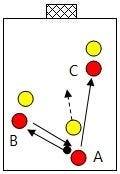
The FA categorizes the lending pass as a three-player move, but it essentially operates as a two-player manoeuvre. A lending pass occurs when a player passes to a teammate and then receives the ball back in a similar position. Both players must be aware that the ball carrier needs support. Typically, the supporting player moves closer to the player in possession to receive the pass. This pass should be smooth and directed to the safe side of the supporting player, allowing them to protect the ball.
In this scenario, moving the ball is intended to shift the opponents' positioning. The supporting player may need to control the ball to encourage the opponents to reposition themselves to defend the new ball carrier, thus creating space for the original ball carrier to receive the return pass. This player will then have time to assess their options and may be able to advance the play effectively.
Set Back Pass
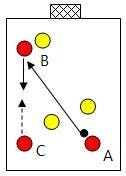
In this move, player A sends the ball quickly to their teammate B, who is facing away from the goal. The fast pass is intended to prevent interception, but since player B is unaware of what’s behind them, they lay the ball off to teammate C, who is approaching the ball and facing forward. Player B’s position often prompts opponents to press them, which creates gaps that player C can exploit to advance the play.
Up, Back and Through
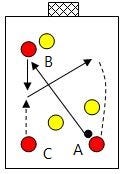
This is essentially the set back pass, only the FA denotes that player C must play a through ball to player A at the end of the sequence.
Three in a Line
As the name suggests, this move begins with three players lined up in any direction. Player A, who has the ball, passes it toward Player B. The intended recipient could either be Player C, or Player C sees an opportunity if the ball runs through them. In either case, Player A or Player C communicates with Player B to signal that they should let the ball pass so that Player C can receive it.
Coaching Considerations
Three-player core moves involve more components, increasing the likelihood of errors. Ultimately, these moves are ideas to help your players collaborate to solve a problem, not something to be perfected or demanded. Football isn't judged on the inclusion of these moves; they aren't inherently better than other combinations, just more common. It's not about your players memorising these combinations but recognising these patterns to anticipate their teammates' actions. This recognition helps develop team chemistry, allowing them to interact fluidly and intuitively.
What gets recognised gets repeated. Observe your players and highlight creative combinations, even if they don't succeed. Let the game continue until a natural stoppage before recreating the situation to emphasise the positive aspects. If unsuccessful, acknowledge the intent and what they were trying to achieve. Rehearse the move successfully, making minor adjustments if needed.
If your players are missing opportunities to solve situational problems, you can stop the game briefly to discuss a possible solution. Ask the supporting players to demonstrate a better/ different supporting positions or ask the player with the ball where they would like the supporting players to be. This encourages your players to exchange ideas and ensures everyone is on the same page. Guide them if necessary, but keep the intervention brief—aim to be in and out in less than a minute. Limit these stoppages to a maximum of 3 minutes in total and cover no more than two core moves per session to avoid overwhelming your players with too much information.
Mastering these three-player core moves requires effective communication, precise execution and coordinated movement. These moves occur naturally, but highlighting them to your players will help them to recognise and utilise these patterns. The key to success lies in your players' ability to read the game and adapt swiftly.
For 87 comprehensive session plans, consider ‘The Soccer Sessions Book’. Each plan includes thought-provoking questions and challenges, along with model answers to help guide your coaching expectations effectively.

Thanks for reading UEFA Coach Paul! Subscribe for free to receive new posts straight to your inbox!
If you found these football/soccer coaching tips and insights helpful, please consider supporting this blog by making a donation to help us continue providing valuable content to coaches like you. Together, we will change the game to be more skilful and exciting!