Understanding the FA Two-Player Core Moves
In football, effective teamwork and communication are crucial for success on the pitch. The Football Association (FA) emphasizes core moves that enhance player coordination and tactical understanding. These simple combinations help maintain possession and navigate past opponents, occurring naturally but benefiting from a shared language among players. In the 2022 World Cup, 56% of open play goals featured at least one core move, with 47% involving at least one two-player move. This article explores two-player core moves that significantly improve team performance.
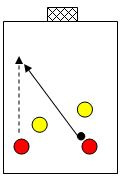
1. Diagonal Pass Straight Run
The diagonal pass straight run involves one player making a diagonal pass to a teammate who is making a straight run toward the goal. This technique effectively breaks defensive lines and creates goal-scoring opportunities. Both players should ensure there is space behind the defence and that the player on the ball has time to play forward. The receiver often runs behind the defender, making it harder for them to track the ball and the run simultaneously. Timing is crucial; the run should coincide with the defender's focus on the ball to gain an advantage. The receiver may use a ‘show and go’ movement to mislead the defender before exploiting the space left behind. The passer must accurately gauge the distance and angle of the pass, potentially using feints to disguise their intention.
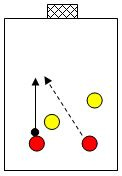
2. Straight Pass Diagonal Run
In contrast, the straight pass diagonal run involves a player making a straight pass to a teammate who is making a diagonal run. This move exploits space on the field, allowing the receiving player to angle their run toward the goal or into open areas. The receiver should ideally be positioned to continue the attack's momentum. Timing and communication are essential, as the passer must anticipate the run and deliver the ball at the right moment.
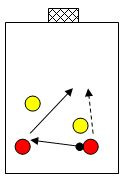
3. Wall Pass
The wall pass, also known as a give-and-go or a one-two, is a dynamic move where one player passes the ball to a teammate and immediately runs to receive it back. This technique is effective in tight spaces and can be played sideways or forward to eliminate defenders. Successful execution relies on a quick exchange of the ball and precise timing, allowing the player to regain possession in a more advantageous position. Both players must recognise the pressure on the player with the ball and identify space to exploit. The ideal pass should be directed to the ‘safe side’ of the wall player, and the return pass can be first-time or taken with a touch to ensure the run is made. The player that passes to the wall player should entice their defender to press them. They might make the pass late and with the outside of their foot so the defender is less likely to anticipate it. They should then change speed quickly once they make the pass to accelerate into the space behind the defender.
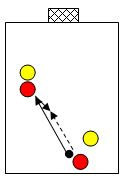
4. Pass and Follow
The pass and follow move involves a player passing the ball to a teammate and then following their pass to create additional options. This technique often leads to a lay-off to set up a shot, but could also facilitate better angles for forward play in the build-up. Both players should be aware of the pressure on the receiver, who often positions themselves with their back to goal to invite pressure. The receiver uses their body to shield the ball and lays it off just as the passer is coming onto the ball, allowing for a quick pass or shot before defenders can react.
5. Overlap
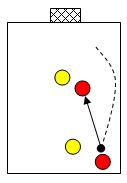
The overlap move involves one player making a run around the outside of a teammate with the ball. This can be made sideways or forwards. This is an effective way to isolate a defender in a 2v1. As the overlapping player approaches, they either receive a pass or create space for the ball carrier. This tactic is particularly effective in wide areas, confusing defenders and leading to scoring opportunities. The player with the ball might start to move inside to create more space for the overlapping player. Synchronisation and communication between both players are vital for success.
6. Takeover
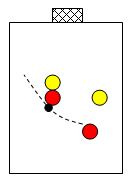
In the takeover move, a teammate runs toward the player on the ball and takes possession. Both players must recognise that the player on the ball is under pressure. The player with the ball shields it while moving toward their teammate and then stops it, enabling their teammate to take it and run into space. This manoeuvre confuses the defenders as to which player they should mark and could block the defender tracking the run. Also, the takeover could be faked, allowing the original player to retain possession after drawing the defender away.
Coaching Considerations
Utilise 2v2 to 4v4 games to provide players with ample opportunities to engage in similar situations.
Implement a variety of practice activities to promote different two-player moves. Modify scoring methods to encourage specific combinations; for example, incorporating two wide dribble gates for each team in 4v4 games promotes wall passes.
Reward successful combinations by increasing the point value of goals scored through them or by allowing players to earn 'super powers' as a result.
The FA's two-player core moves are essential techniques that enhance teamwork and tactical awareness on the football field. By mastering these moves—diagonal pass straight run, straight pass diagonal run, wall pass, pass and follow, overlap, and takeover—players will improve their collaboration, create scoring opportunities and contribute to their team's success.
For 87 comprehensive session plans, consider ‘The Soccer Sessions Book’. Each plan includes thought-provoking questions and challenges, along with model answers to help guide your coaching expectations effectively.

Thanks for reading UEFA Coach Paul! Subscribe for free to receive new posts straight to your inbox!
If you found these football/soccer coaching tips and insights helpful, please consider supporting this blog by making a donation to help us continue providing valuable content to coaches like you. Together, we will change the game to be more skilful and exciting!